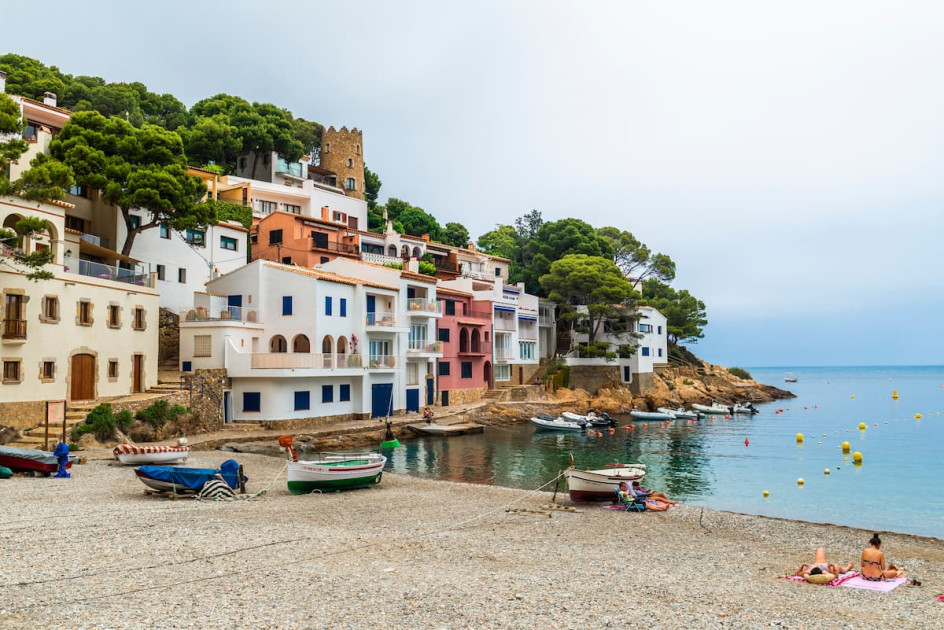
Plusvalía tax in Spain when selling your house: how it's calculated in Girona and the Costa Brava
Plusvalía tax (plusvalía municipal) is the tax the seller pays to the town council when selling a house on urban land, and it only taxes the increase in the value of the land, not of the building. It is calculated in two ways (the objective method or the actual method) and you pay whichever is cheaper. Each town council that applies this tax sets its rate in its by-law, up to a maximum of 30%, and if you sell without a gain you pay nothing, although you must declare the sale within 30 working days.
In this guide we explain step by step how it is calculated using the coefficients in force in 2026, what each municipality sets, with indicative examples of amounts, and which specific rules apply to inheritances, masías (traditional country houses) and non-resident owners.
Plusvalía municipal is the popular name for the Spanish tax on the increase in value of urban land, officially the Impuesto sobre el Incremento de Valor de los Terrenos de Naturaleza Urbana (IIVTNU), known in Catalan as impost sobre l'increment de valor dels terrenys de naturalesa urbana or simply "plusvàlua". It is regulated by articles 104 to 110 of the consolidated text of the Local Finance Act (Royal Legislative Decree 2/2004) and is managed by the town council of the municipality where the property is located.
The tax becomes due every time an urban property changes hands: in a sale, an inheritance or a gift. Under article 106 of the Local Finance Act, in a sale the seller pays; if the seller is an individual who is not resident in Spain, the buyer acts as a substitute. In inheritances and gifts, the person who receives the property pays: the heir or the recipient of the gift.
They are often confused. Plusvalía tax is a local tax that only taxes the increase in the value of the land. The capital gain under IRPF (Spanish personal income tax) is a state tax on the total difference between the purchase price and the sale price (land plus building) and is declared in the following year's income tax return.
Both are paid on the same transaction, but they are linked: the amount of plusvalía tax paid by the seller is deducted from the transfer value when calculating the IRPF gain, under article 35 of the IRPF Act. For an overview of all the taxes and costs of a sale, see our guide to the costs of selling a house.
Since the reform of November 2021, the taxable base can be calculated in two ways and the taxpayer is entitled to apply whichever is more favourable. The town council's rate, which can never exceed 30%, is then applied to that base.
This is the traditional system and the one most town councils apply by default. The cadastral value of the land on the date of sale is multiplied by a coefficient that depends on how many years you have owned the property.
Formula: cadastral value of the land × coefficient based on years of ownership = taxable base. Tax due = taxable base × municipal tax rate.
The cadastral value of the land is shown separately on the IBI (council tax) bill, distinct from the value of the building, and can also be checked on the Cadastre's online portal. Under article 107.4 of the Local Finance Act, to determine the applicable coefficient the period of ownership is counted in complete years, without fractions, up to a maximum of 20 years. If the transfer takes place before one full year, complete months are used.
This method starts from what you have actually gained. The difference between the sale price and the purchase price stated in the deeds is calculated, and the percentage that the land represents of the property's total cadastral value is applied.
Formula: (sale price − purchase price) × % of the land in the total cadastral value = taxable base. Tax due: taxable base × municipal tax rate.
A detail many sellers are unaware of: for this calculation the law does not allow you to add the purchase costs (notary, land registry, transfer tax, agency fees) or deduct the sale costs. The values stated in the deeds are compared as they are, or the value verified by the tax authorities if higher.
Constitutional Court Ruling 182/2021 struck down the previous system because it required payment even when selling at a loss. Royal Decree-law 26/2021 introduced the two current methods and the exemption from the tax where there is no increase in value.
This exemption is not automatic. You must file the declaration on time and provide the purchase and sale deeds. In some by-laws, such as Palafrugell's, failing to file it is expressly classed as a tax offence, even if the tax due is zero.
The maximum coefficients in the table below apply until 30 November 2026. They come from article 24 of Royal Decree-law 8/2023 and are the same as those applied in 2024 and 2025. Royal Decree-law 16/2025 set a different scale from 1 January 2026, but Parliament repealed it on 27 January. Royal Decree-law 29/2026 provides for new maximums from 1 December 2026 and, as of 17 October, is awaiting parliamentary ratification.
| Years of ownership | Maximum coefficient | Years of ownership | Maximum coefficient |
|---|---|---|---|
| Less than 1 year | 0.15 | 11 years | 0.10 |
| 1 year | 0.15 | 12 years | 0.09 |
| 2 years | 0.14 | 13 years | 0.09 |
| 3 years | 0.14 | 14 years | 0.09 |
| 4 years | 0.16 | 15 years | 0.09 |
| 5 years | 0.18 | 16 years | 0.10 |
| 6 years | 0.19 | 17 years | 0.13 |
| 7 years | 0.20 | 18 years | 0.17 |
| 8 years | 0.19 | 19 years | 0.23 |
| 9 years | 0.15 | 20 years or more | 0.40 |
| 10 years | 0.12 |
These are maximum coefficients: each town council can approve lower ones in its tax by-law. It is common to find by-laws that simply apply the national maximum, but each municipality should be checked. Palafrugell, for example, states that the maximum in force applies and is updated automatically when the law changes.
For transfers that took place between 1 and 27 January 2026, the coefficients of Royal Decree-law 16/2025 applied. Its repeal took effect on 28 January, so there are no grounds to correct a self-assessment solely because the rule was later repealed. A correction would only make sense if there were another error in the calculation or in the application of the by-law.
The scale applicable until 30 November 2026 follows a counter-intuitive curve. The lowest coefficients fall between 11 and 16 years of ownership (0.09–0.10), and the highest appears at 20 years (0.40), almost double that at 19 years (0.23).
On that scale, for a villa with a cadastral land value of €240,000 and a 30% rate, selling after 19 years of ownership means a tax bill of €16,560 under the objective method. If completion is delayed and the 20 years are reached, the bill rises to €28,800: €12,240 more for a few weeks' difference. If you are close to that threshold, check the exact date of your purchase deed before setting the date of the sale.
To show how the result changes depending on the gain and the years of ownership, the following cases apply a 30% tax rate and the national maximum coefficients in force until 30 November 2026, as set out in the Palafrugell by-law.
The three examples are indicative and use hypothetical cadastral values.
| Item | Case A | Case B | Case C |
|---|---|---|---|
| Purchase / sale | 2008: €600,000 2026: €1,200,000 |
2021: €350,000 2026: €365,000 |
2019: €900,000 2026: €870,000 |
| Years of ownership (coefficient) | 18 years (0.17) | 5 years (0.18) | 7 years (0.20) |
| Cadastral value of the land (% of total) | €240,000 (60%) | €67,500 (45%) | €180,000 (50%) |
| Tax under the objective method | 240,000 × 0.17 × 30% = €12,240 |
67,500 × 0.18 × 30% = €3,645 |
Not applicable |
| Tax under the actual method | 600,000 × 60% × 30% = €108,000 |
15,000 × 45% × 30% = €2,025 |
No increase |
| Plusvalía tax payable | €12,240 (objective method) |
€2,025 (actual method) |
€0 (not subject, but must be declared) |
The practical takeaway is clear. With large increases in value and long periods of ownership, as in case A, the objective method is far more favourable than the actual method. With small increases, as in case B, the actual method is better. In case C nothing is due because there is no increase in value, but the transfer must be declared and supported with the purchase and sale deeds.
National law sets the framework, but the final amount depends on each municipality's tax by-law. That is why two identical houses in different towns can pay different amounts. The elements each town council decides are:
Before calculating plusvalía tax, always check the by-law in force in the municipality where the property is located: national law sets maximum coefficients, but each town council can approve lower coefficients and set its own tax rate and relief.
It is filed with the town council where the property is located or with the body to which it has delegated tax management. In the province of Girona, many municipalities have delegated tax management to XALOC, the tax collection agency of the Diputació de Girona, and in the Baix Empordà some town councils have delegated the IIVTNU to the Consell Comarcal (county council). Others, such as Palafrugell, manage it directly. Each municipality's online portal explains where and how to file the form.
When the house is inherited, the heir is liable for payment. Many town councils offer relief if the property was the deceased's main home and it is inherited by close relatives.
Palafrugell offers an example of graduated relief: the percentage decreases as the land area increases.
| Area of land transferred | Tax relief |
|---|---|
| Less than 200 m² | 95% |
| Between 200 and 300 m² | 75% |
| Between 300 and 400 m² | 50% |
| Between 400 and 500 m² | 25% |
| More than 500 m² | 10% |
The relief requires the property transferred to have been the deceased's main home and last registered address (empadronamiento). In addition, the heir must have been continuously registered on a municipal register for the two years before the death. They do not need to have lived with the deceased or to have been registered at that property: they may have been registered at another address. According to the literal wording of the by-law, it does not specify that this other address must be in Palafrugell either. The relief also requires the property not to be sold for the following three years. If the heir sells earlier, they must repay the difference with interest.
It depends on the cadastral classification of the land, not on what the property looks like. A masía on rural land is not subject to plusvalía tax, even if it includes a renovated luxury home. But some masías and village houses in inland Empordà are recorded in the Cadastre as urban, and then they are taxed.
With urban land and building plots, the situation is the opposite: the entire cadastral value corresponds to the land, so the taxable base under the objective method is usually higher than for a home of the same price. Before selling, check the cadastral certificate to see whether the property is rural, urban or mixed.
Many property owners on the Costa Brava are foreigners who are not tax resident in Spain. In these cases, article 106.2 of the Local Finance Act makes the buyer the substitute taxpayer: the buyer is liable to the town council for payment of plusvalía tax, and the Palafrugell by-law states this expressly.
Buyer and seller can agree that the plusvalía amount is deducted from the price at completion. It is also common for the estate agency to handle the payment on the seller's behalf. In sales by a non-resident individual, this arrangement does not change legal liability: the buyer is liable to the town council as substitute taxpayer. A separate withholding is added to this amount: 3% of the price, which the buyer must pay to the Spanish Tax Agency (Agencia Tributaria) on account of the non-resident seller's income tax (form 211). These are two different taxes, and it is advisable to calculate both before setting the net price the seller will receive.
The deadline to file plusvalía tax on a sale is 30 working days from the signing of the deed. For inheritances it is six months from the date of death, extendable to one year if requested within the first six months.
If the municipality requires self-assessment, filing late without a prior demand can lead to the surcharges under article 27 of the General Tax Act, which start at 1% and increase for each full month of delay. In addition, article 254.5 of the Mortgage Act prevents the Land Registry from registering the transfer until the filing of the self-assessment or declaration, or the legal notification to the town council, has been proven. Proof of payment is not required.
The usual steps are:
You will already need most of these documents for the sale; we go through them all in our checklist of documents needed to sell a house in Spain.
There are no shortcuts, but some decisions change the amount significantly:
If you are thinking of selling and want to know the real net price of the transaction, including plusvalía tax, income tax and costs, our service to sell your house on the Costa Brava prepares that estimate before going to market, and our legal services team reviews the tax documentation for the sale.
Information updated on 17 October 2026 with Royal Decree-law 29/2026 and the Palafrugell tax by-law. The table and examples use the coefficients applicable until 30 November 2026; the new scale planned for 1 December was awaiting parliamentary ratification on the date of the update. This article is for information purposes only; the exact amount depends on the by-law in force in each municipality and the circumstances of each transaction.