Selling a house in Spain involves much more than finding a buyer and agreeing on a price. Before signing, the seller has to cover a series of costs and taxes that usually account for between 5% and 15% of the sale price, depending on the type of property, its location and the owner's personal circumstances.
Knowing in advance how much you pay to sell a house makes it possible to plan the transaction, avoid surprises at the notary's office and negotiate from a stronger position. Below we break down all the costs of selling a house, with guide prices and a summary table.
The usual split of costs between the parties in Spain is as follows.
Costs borne by the seller:
Costs borne by the buyer:
This split is not set in stone: the parties may agree in the contract who takes on each cost, except for the taxes that the law expressly assigns to one of them.
Taxes are by far the largest of the costs involved in selling a house. You can find more detail in our guide to the taxes when selling a house.
When the sale price exceeds the purchase price plus deductible expenses, that difference is taxed under IRPF as a capital gain, at the following rates:
| Gain bracket | Tax rate |
|---|---|
| Up to €6,000 | 19% |
| €6,001 to €50,000 | 21% |
| €50,001 to €200,000 | 23% |
| Over €200,000 | 26% |
There are three situations that reduce or remove this tax liability:
The municipal capital gains tax (IIVTNU) is levied on the increase in the value of the land between purchase and sale. Following Royal Decree-Law 26/2021, taxpayers can choose whichever calculation method is more favourable: the objective method, which applies coefficients to the cadastral value of the land, or the real method, based on the actual increase evidenced by the title deeds. If there has been no real increase in value, no payment is due, provided this can be documented. The amount varies considerably depending on the municipality and the number of years of ownership.
If the property still has a mortgage on it, cancellation takes place in two stages. Financial cancellation means settling the outstanding debt with the bank, usually at the moment of signing. Some lenders charge an early repayment fee, capped by law: 0.25% of the capital during the first three years, 0.15% between the third and fifth year, and no fee from the fifth year onwards on variable-rate mortgages (Law 5/2019).
Registry cancellation requires a notarial deed in order to lift the charge at the Land Registry:
In total, cancelling a mortgage at the Land Registry usually costs between €600 and €1,200.
In Spain, estate agency fees are not regulated by law and are freely agreed between the parties. The usual range is between 3% and 5% of the sale price plus VAT, although some agencies charge a flat fee and there are online models with lower commissions and a lower level of service.
On a sale of €500,000 with a 4% commission, the fees would come to €20,000 plus €4,200 in VAT, that is, €24,200. This commission is deductible from the transfer value, which reduces the capital gain subject to income tax.
It is worth seeing these as an investment rather than merely an expense: good preparation shortens the time it takes to sell.
Selling a property received through inheritance brings additional costs. Before selling, the heirs must have settled inheritance tax, the amount of which depends on the autonomous region, the degree of kinship and the value of the estate; in Catalonia there are allowances for spouses and children. Municipal capital gains tax must be settled within six months of the death, extendable to one year.
For income tax purposes, the acquisition value used is the one declared in the deed of acceptance of inheritance, not the price the deceased originally paid: if it was set at market value, the capital gain may be low or even nil. Where there are several heirs, the costs of division and allocation are added. You will find the full process in our guide on how to sell an inherited house.
| Item | Paid by | Guide cost |
|---|---|---|
| Income tax (capital gain) | Seller | 19% – 26% of the gain |
| Municipal capital gains tax | Seller | Varies by municipality and years of ownership |
| Energy performance certificate | Seller | €80 – €300 |
| Certificate of habitability (Catalonia) | Seller | €80 – €150 |
| Mortgage cancellation at the Land Registry | Seller | €600 – €1,200 |
| Estate agency commission | Seller | 3% – 5% of the price + VAT |
| Early repayment fee | Seller | 0% – 0.25% of the capital |
| Copy of the deed of sale | Seller | €30 – €100 |
| Administrative agency (optional) | Seller | €150 – €500 |
| Pro rata IBI for the year | Negotiable | Variable |
A large proportion of Costa Brava owners are foreign nationals or non-tax-residents in Spain. In those cases, the buyer must withhold 3% of the sale price as a payment on account of non-resident income tax, and the seller then files form 210 within four months.
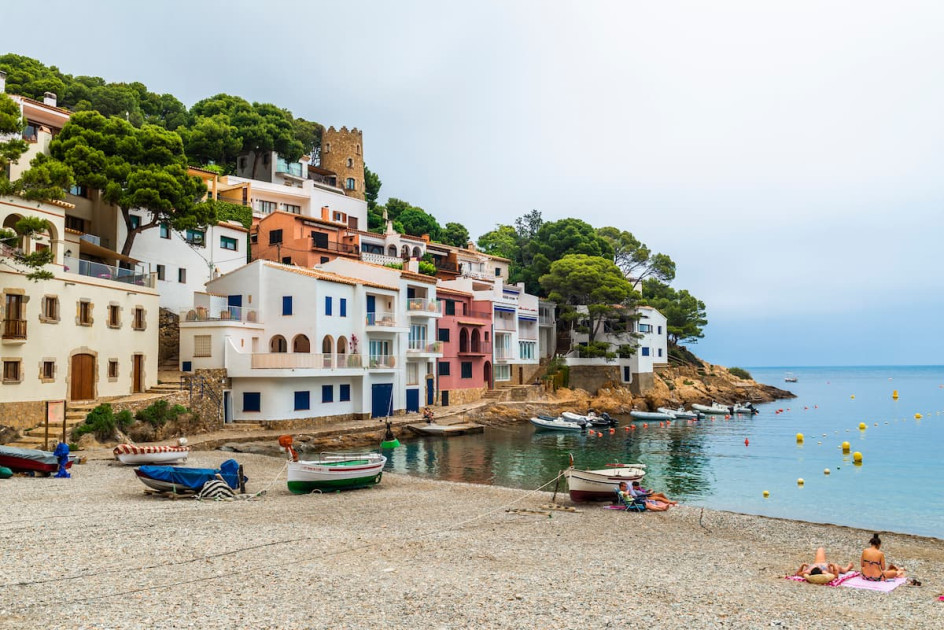
On high-value properties, such as those typically found in Begur, Llafranc, Aiguablava, Sa Tuna and Tamariu, the income tax and municipal capital gains tax amounts are substantial, so planning ahead (reinvestment in a main residence or the age-based exemption) can deliver significant savings. Given the range of seller profiles and property types (masias, villas, apartments and plots), working with an estate agency that specialises in the Costa Brava makes it possible to optimise costs and anticipate any tax or registry complications.